
How did awnings originate?
The predecessors of today’s awnings can be traced back to ancient Egypt and Syria. Woven mats were used to shade market stalls as well as areas around residential homes. In modern times, outdoor fabric shading became widespread in the first half of the 19th century. The fabric was supported by a wooden or steel structure. In the United States, awnings in front of shops and homes became especially popular after the Civil War.

At that time, however, they had many drawbacks: the structure was fixed, and the fabric had to be retracted manually. Later, mechanisms to simplify retracting awnings began to appear, especially rope-and-pulley systems. Even with this help, awnings usually could not be fully retracted, and the overhanging fabric could fade due to sunlight, obstruct the view, or look untidy.
Modern awnings have solved all these problems. They can be fully retracted, either manually using a crank or through various electric control options. In addition, different tensioning systems have been developed—articulated arms, for example, allow for a greater extension than the width of the awning.
What are awnings used for and what types are available?
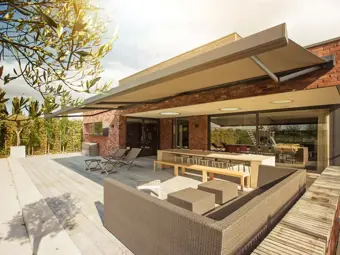
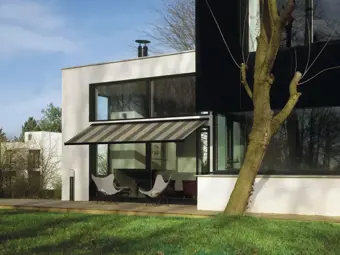
Structurally, there are two main types of awnings today: dome awnings, typically used in front of shops and businesses, and patio awnings, which provide shade for balconies or terraces. If you don’t have a pergola on your terrace, an awning is an ideal shading solution: it blocks the sun, withstands light rain, and does not obstruct the view.

If you choose electric control, you also eliminate the need for manual handling required with something like a patio umbrella—removing a protective cover, often with the help of an extension pole, unfolding it with a crank, tilting it… with an electrically controlled awning, you simply press a button. Or not even that: awnings can be equipped with sun/wind sensors that retract or extend them automatically depending on the weather. Alternatively, you can integrate awnings into your TaHoma smart home system and control them via your phone or schedule their operation in advance according to your daily routine.