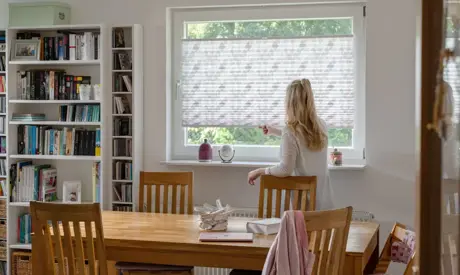
Curtains cover, roller shutters roll up
A translucent or semi-transparent fabric hanging, designed to prevent people outside from seeing into the room, has been known in English as a "curtain" for many centuries. It comes from Old French (courtine), which itself comes from the Latin word cortina for an enclosed space, a court. From this, we can see quite clearly that its purpose is to cover, enclose a space. The Czech word for a curtain, "záclona", comes from the verb clonit, i.e., screen or shade. And there is no mystery in the name for the roller shutters, either. It is a fabric wound onto a shaft that rolls it down or up as needed. The Czech term roleta arguably comes from the German word Rollette, derived from the French roulette, which comes from the verb rouler – roll up.

Blinds against jealousy
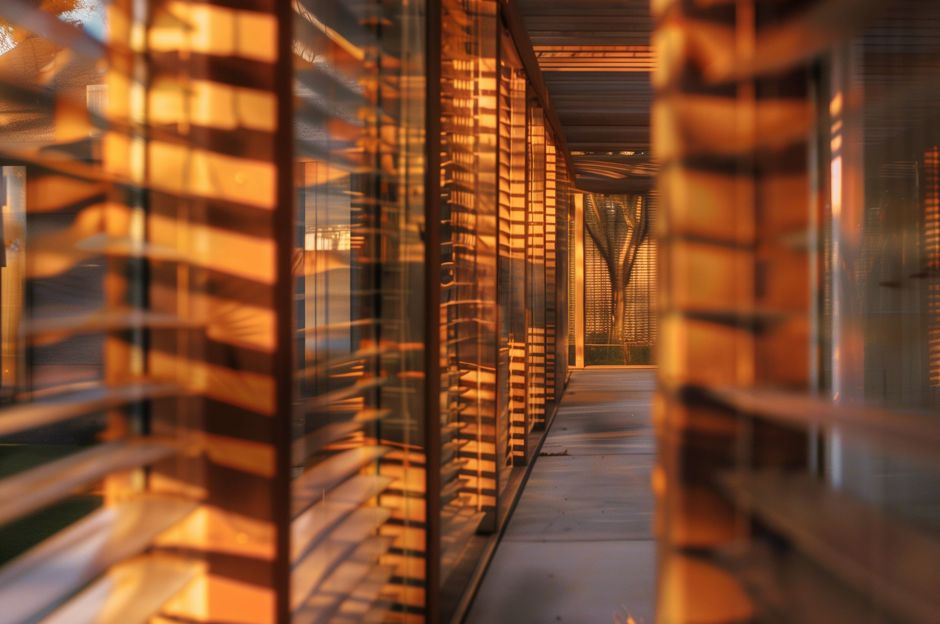
Window blinds were first used by Oriental rulers in their harems. They did not want anyone from outside to be ogling their harem beauties, so they were using shutters made of wooden slats, which were initially fixed in place and let light in but kept prying eyes out. The Czech term for a window blind, žaluzie, is semantically close, as it refers to the French word for jealousy – jalousie.
Awning for a marquise
The Czech term for an awning, "markýza", is a homonym that also denotes a marchioness. It likely refers to the use of various sunshades and tents by French noblewomen, spots so elaborately decorated and pleasantly shaded that it was even suitable for them to spend time there. In American English, a fabric roof-like structure above shop windows is called a "marquee", which is also derived from the French word marquise (marchioness).
Pergola
The word for "pergola" is similar in most Indo-European languages. It comes from the Latin word pergula of uncertain origin, meaning an attachment to a building, arbour, but also a stall in front of the house or a hut.

Plisse, screen roller shutters, and Japanese blinds
The French word plissé means pleated, usually referring to a fabric with parallel folds made in it by pressing. Whether pleated skirts are in fashion at the moment or not, pleated (Plisse) blinds are certainly setting the trend. They combine an elegant and modern look with practicality, versatility, and easy maintenance.
Screen roller shutters are meant to block the light coming from the outside as much as possible by means of using a special fabric that screens out the sun's rays.
Japanese blinds indeed come from Japan, where they have a long tradition. They were originally made from paper and wood, but modern materials are used nowadays. What remains the same is their elegance, how they enliven the interior and allow light to filter through. Japanese panels can therefore be used for shading windows of any size as well as partitioning the interior.